
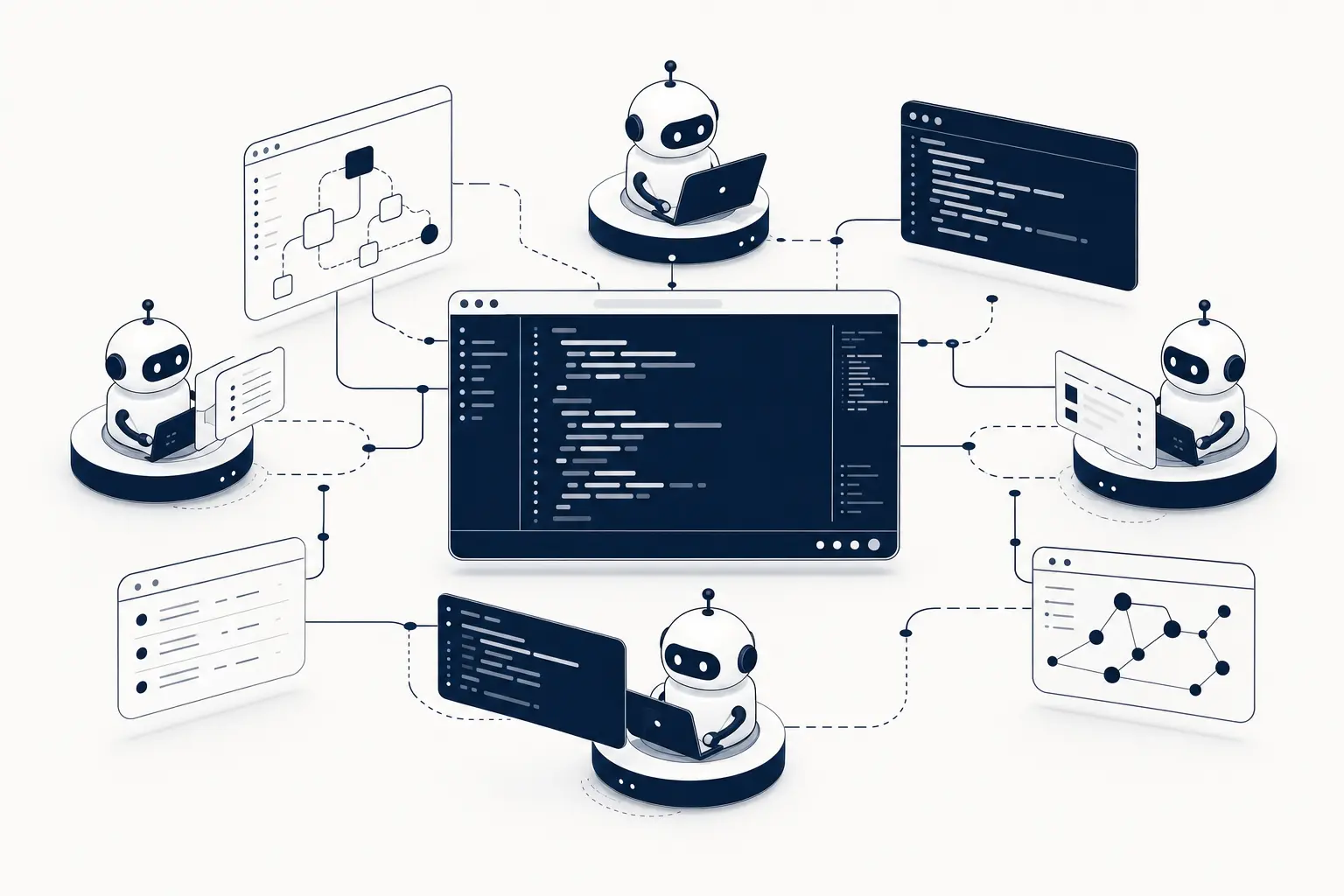
Somewhere in 2026, "AI coding tool" stopped meaning autocomplete and started meaning a teammate. The tools that define this year don't just suggest the next line — they read your repository, plan a multi-step change, write the tests, run them, fix what broke, and hand you a pull request. That shift has a name: agentic coding. This is a field guide to that landscape, who's in it, and what it means for anyone building software right now.
Assistant vs. agent: the line that matters
An AI assistant waits for you. You type, it completes; you ask, it answers. An AI agent acts. Give it a goal — "add rate limiting to the auth endpoint and prove it with tests" — and it decomposes the task, edits multiple files, executes commands, reads the failures, and iterates until it's done.
The front-runners of 2026 — Claude Code, Cursor, Codex, GitHub Copilot's agent mode, Cline — crossed that line. They're agents, not just assistants. The practical consequence: you spend less time writing code and more time specifying and reviewing it. Your job shifts from typist to tech lead.
The four shapes of a coding agent
The landscape looks crowded until you sort it by where the agent lives. There are roughly four shapes:
1. CLI agents (terminal-native). These live in your shell and treat the whole repo as context. Claude Code is the archetype — a fully autonomous agent with minimal approval friction, tuned for large, multi-file work. GitHub's Copilot CLI graduated from preview in 2026 with multi-turn autonomous sessions that can browse the web, read docs, and execute code in isolated containers.
2. IDE-integrated agents. Cursor is the reference point: a full editor where the agent works alongside you with instant visual feedback. Great when you want to stay in the loop on every change instead of handing off a whole task.
3. Autonomous software engineers. Devin, from Cognition AI, is the clearest example — an agent that plans, writes tests, and ships production code across multi-step tasks inside your existing codebase and toolchain, without constant hand-holding.
4. Full-stack cloud agents. Replit Agent plans, writes, tests, and deploys entire applications from the cloud. Its Agent 4 release (March 11, 2026) added parallel task forking that auto-resolves merge conflicts roughly 90% of the time — a signal of where multi-agent workflows are heading.
Most serious builders don't pick one shape. They keep a CLI agent for heavy lifting, an IDE agent for tight-loop work, and reach for a cloud agent when they want something shipped end-to-end.
MCP: the quiet standard that ties it together
The most important thing to happen to coding agents in 2026 isn't a single tool — it's a protocol. MCP (Model Context Protocol) is the emerging standard that lets agents connect to external data sources, APIs, and tools through one unified interface. Nearly every major coding agent now speaks MCP.
Why it matters: before MCP, giving an agent access to your database, your design files, or your issue tracker meant a bespoke integration for each tool. With MCP, those become composable plugins. The agent ecosystem stops being a set of walled gardens and becomes a toolkit you assemble. If you're betting on agentic workflows long-term, MCP support is the compatibility layer to watch.
What agentic coding actually changes for builders
For a founder or a small team, the agentic shift compresses the distance between idea and shipped product dramatically. A working backend, auth, and a dashboard that used to be a week of work can be a focused afternoon of specifying and reviewing.
But speed exposes a different bottleneck. When an agent can generate a functional app in an afternoon, the thing that separates a product that looks funded from one that looks like a weekend hack is no longer the code — it's the design. Agents are excellent at logic and terrible at taste. They'll give you a working signup flow and a homepage that undersells everything behind it.
That's the trap of pure velocity: you ship fast and look cheap. The fix isn't to slow down — it's to not design the interface from zero. Pair your agent-built product with production-ready landing page design and professional Figma templates so the surface matches the speed of the build. If you're choosing tools, our breakdown of the best AI coding tools in 2026 pairs well with this guide, or you can browse every collection to see what a finished screen should feel like.
How to actually adopt agents without chaos
A few patterns that separate teams who get leverage from agents from teams who get a mess:
- Specify like a tech lead. Vague prompts produce vague diffs. Write the goal, the constraints, and the definition of done. The agent is only as good as the spec.
- Review every diff. Agentic speed is a multiplier on both good and bad decisions. The human stays on the pull request.
- Let the agent own the boring loop. Tests, refactors, migrations, boilerplate — hand these off completely. That's where autonomy pays.
- Keep taste human. Architecture direction, product decisions, and visual design are still yours. Agents accelerate execution; they don't set the vision.
The 2026 landscape in one line
Coding agents in 2026 are diverse by design: specialized CLI agents, integrated IDEs, autonomous engineers, and full-stack cloud workers, increasingly wired together by MCP. The winners aren't the people with the single best tool — they're the ones who assemble a workflow: an agent to build it fast, and great design to make it look like it deserves to exist.
Frequently asked questions
What are agentic coding tools?
Agentic coding tools are AI systems that don't just autocomplete code — they autonomously plan a task, edit multiple files, run commands and tests, and iterate until the goal is met. In 2026 the leading examples include Claude Code, Codex, Devin, GitHub Copilot's agent mode, and Replit Agent.
How are coding agents different from AI assistants?
An assistant reacts to each prompt (suggest a line, answer a question). An agent takes a high-level goal and executes the whole multi-step task — decomposing it, writing and running code, and fixing failures — with far less human input per step.
What is MCP in agentic coding?
MCP (Model Context Protocol) is a 2026 standard that lets coding agents connect to external data, APIs, and tools through one unified interface. Because nearly every major agent supports it, MCP turns integrations into composable plugins instead of bespoke, one-off connections.
Which agentic coding tool should I use?
It depends on where you work: Claude Code and Copilot CLI for terminal-native autonomous work, Cursor for IDE-integrated feedback, Devin for autonomous engineering inside an existing codebase, and Replit Agent for building and deploying full apps from the cloud. Most teams combine several rather than standardizing on one.